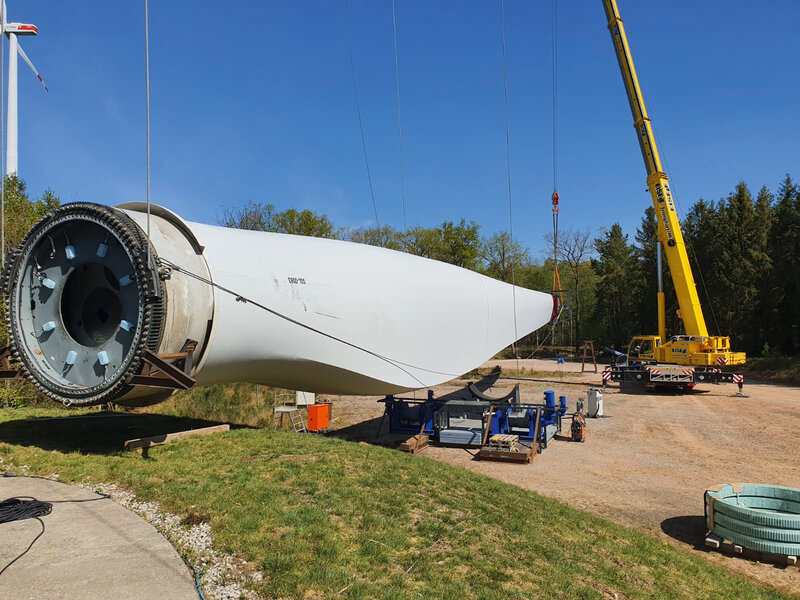
The term "large component" is dimensionally correct, but it doesn't quite do the component justice. "Core component" would be a better description because these components are crucial for the operation of a turbine: If they fail, this inevitably means downtime for the turbine. It's the worst case scenario for every operator, since not only does the feed-in tariff fail, but they are faced with high costs for repairs or replacements. In particular, logistics and the use of large cranes have a financial impact on dismantling. In the search for alternative techniques, GFW, a subsidiary of Deutsche Windtechnik, has developed a ground-based winch system (BGWS), which was used successfully for the first time this year.
Financial and logistical benefits are proven
"The capabilities of the winch system are versatile and always lead to cost reductions," said Jürgen Fuhrländer, Managing Director of GFW.
- Currently suitable for hub heights of up to 145 m and blade lengths of up to 60 m; successive expansion of the design limits is planned.
- Can be carried out safely at wind speeds of up to 12 m/s
- Suitable for conventional truck transport
- There is no need to expand local infrastructure for large cranes.
- The financial benefit of the system is obvious. Even when you factor in the costs for preparation, assembly, execution and disassembly, it is more cost-effective than using a large crane to do the same work.
"For larger orders, the savings may amount to a high five or six-figure sum," said Jürgen Fuhrländer, envisaging a positive future outcome for existing projects. The winch system was originally developed for repairing rotor blades and damaged blade bearings, but it has also recently been upgraded and used for replacing generators.
Safety is a priority
Using this system requires in-depth knowledge of static and dynamic conditions and precision in the execution of the work. All those involved in the project implementation must have reliable understanding of their task at all times and must follow the established procedures in accordance with regulations, which is why this system must only be implemented by a trained team of specialists. The BGWS is designed to detach the rotor blade from the rotor hub, lower it and place it onto the blade support using a combination of operating and support winches, rope attachment points, guides/pulleys, support frames and counterweights. Since the ropes are not detached from their attachment points after lowering the rotor blade, it can also be lifted and reassembled by reversing the process.
One technical step ahead
Deutsche Windtechnik has a long tradition of developing its own systems. The ADLS Box, the rotor blade clamping system, several converter solutions and numerous upgrades are successful examples of this. Technology as well as the framework conditions for the wind energy industry are constantly evolving, so there is a need for continuous innovation. Matthias Brandt, Director at Deutsche Windtechnik AG: "We have many engineers and technicians on our staff who are really passionate about looking for innovative solutions, as well as personnel who make the product marketable. This is our great advantage as a medium-sized company. Here, everyone can make the most of their strengths and the process from idea to implementation is short."