"Blade bearings are inherently a black box," explains Silvio Matysik, Engineer Mechanic Components (Construction, R&D) at DWT. "The design allows only external inspections: visual and acoustic examination, supplemented by grease analysis. But the permanent grease lubrication and encapsulation make it virtually impossible to see inside the bearing. Even endoscopy can fail because the grease blocks the view everywhere."
A systematic risk with severe consequences
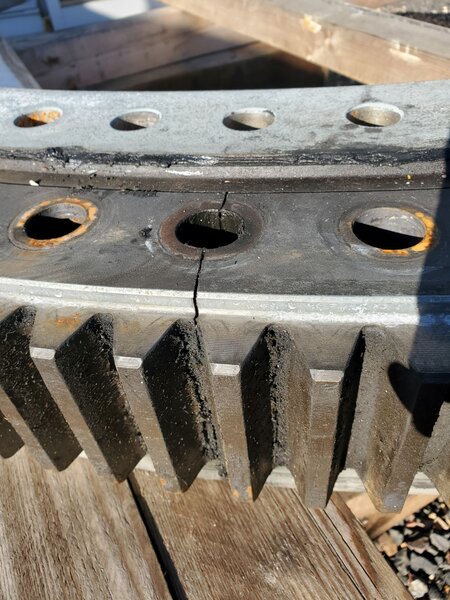
The scale of the problem is evident in DWT's maintenance fleet: to date, we have systematically documented damage cases at 30 turbines, all of them blade bearings on Senvion turbines. "In Senvion MM & 3XM turbines, 99 per cent of blade bearing replacements are due to cracks in the outer ring. This is always associated with a disproportionately high risk of blade throw. We also replace blade bearings on other turbine types, but there wear is the decisive factor," explains Martin Lassen, Sales Manager Complementary Products & Services at DWT. The consequences of blade throw can be severe: in addition to losing the rotor blade, the drivetrain can be affected. "In some cases, wind turbines had to be completely decommissioned due to tower damage," reports Martin Lassen. According to DWT's assessment, this is a systematic risk that develops over the operating life through load, corrosion, and fatigue influences. These are not isolated cases. Crack development extends over several months, sufficient time for early detection if the right system is installed.
Why Senvion turbines are particularly vulnerable
The design of the hub body is crucial: "At the time, Senvion decided to keep the hub bodies small, even though longer rotor blades required larger diameters," explains Silvio Matysik. "The solution was to bolt the inner ring to the hub body and the outer ring to the rotor blade. What was not adequately considered: a rotor blade root is relatively soft and deforms quite significantly." This design, combined with missing or damaged corrosion coating in the bolt holes, means that even the smallest rust deposits are sufficient to trigger crack formation.
Monitoring methods compared
To manage this long-known risk, "traditional" monitoring methods are still predominantly used on Senvion turbines today: regular visual inspections ("Quick Checks") and the manufacturer-developed CMBB (Condition Monitoring Blade Bearing) monitoring system. Increasingly, the modern and considerably more reliable BBG+R system (Blade Bearing Guard Plus Rupture) is being deployed. Practical experience with the traditional methods reveals significant weaknesses.
- Quick Checks: Necessary but not sufficient
The affected Senvion turbines require quarterly or six-monthly "Quick Checks": visual inspection plus looseness testing of the bolted connection. These are considered minimum measures for early crack detection but always represent only a snapshot. Months can pass between two inspections, sufficient time for critical crack development. Moreover, manual inspection procedures are naturally subject to human error that cannot be completely eliminated.
- The Senvion CMBB system: Gaps and cost drivers
The manufacturer Senvion introduced the CMBB system at the time. It detects damage indirectly through the fracture of a nut in the bolted connection. Practical experience with CMBB also reveals weaknesses, as Martin Lassen explains: "The system favoured by the manufacturer is very susceptible. This, together with the necessary troubleshooting operations, not infrequently results in additional downtime." From the serviced fleet, Deutsche Windtechnik reports recurring false alarms with unnecessary turbine shutdowns that directly lead to yield losses.
Even more technically critical: the system does not completely cover the at-risk area that needs monitoring. In cases where the nut is merely cracked or the crack path runs between the holes, crack detection by the CMBB system is not possible. Manual inspections therefore remain necessary despite the installed monitoring system. Consequently, operating and maintenance costs rise, as do uncertainties regarding availability and planning.
360° monitoring with optical fibres: BBG+
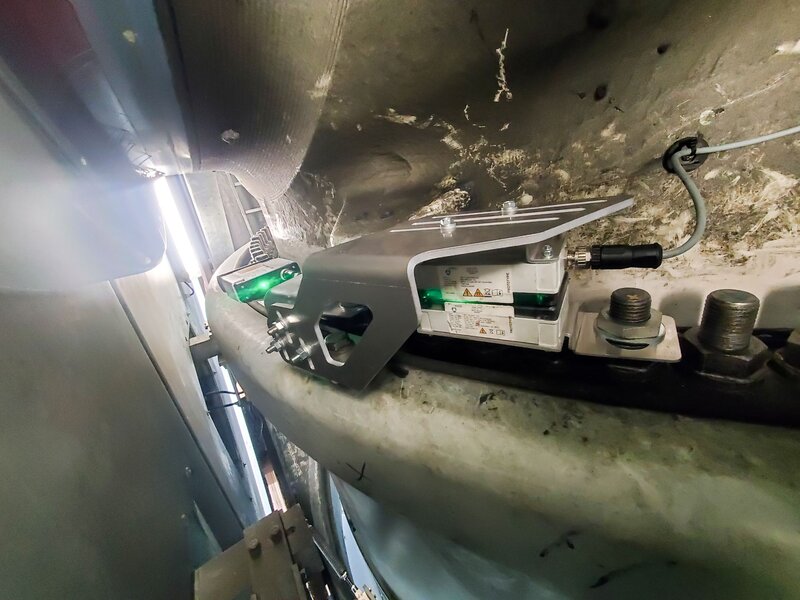
From an economic perspective, the problem becomes even clearer, because the cost of an overlooked crack is not in the defective component itself but in the downtime, logistics, and escalating risk. In the worst case, a matching rotor blade must be reprocured, which is often difficult to obtain. These costs rise exponentially the later a defect is discovered. This is where the monitoring system Blade Bearing Guard Plus Rupture (BBG+R) developed by eolotec and DWT comes in. Unlike Quick Checks (spot checks) or CMBB (incomplete with false alarms), BBG+R monitors the blade bearing continuously across 360° of the outer ring and without false alarms.The BBG+ main component consists of a polymer fibre, an optical waveguide. "Unlike glass fibre, this polymer fibre can be bent without problems. That makes it very robust," explains Martin Lassen. The fibre is bonded completely around the blade bearing outer ring. "Using laser technology, we transmit a light signal through the polymer fibre. When a crack develops at any point on the blade bearing, the signal is altered by the elongation of the polymer fibre. This change can be detected at high resolution using the sensor technology."
BBG+I with stiffening plate enables controlled continued operation
The decisive difference from traditional methods: BBG+ replaces the inspection interval with permanent monitoring. "BBG+ is the only system that significantly reduces the risk of blade failure and detects it early. Furthermore, its constant, high and reliable measurement accuracy means the turbine can continue operating in a controlled manner through monitoring," emphasises Martin Lassen. In almost all blade bearing damage cases registered to date, DWT was able to install a stiffening plate after crack detection and continue operating the turbines after installing BBG+I (Inductive) until the scheduled blade bearing replacement, instead of having to shut them down immediately. Blade bearing replacement can therefore be proactively planned.
Key Facts BBG+:
- Detection accuracy
- 24/7 online monitoring via eolotec platform
- Automatic alarm notification to control room upon crack detection
- DNV-certified and KRITIS-compliant (autonomous from turbine control)
- Installation effort: on average 2 working days with 2 fitters = only 16 hours downtime
From pilot project to standard, from recommendation to requirement
DWT recommends installing the BBG+ system for all affected Senvion types in the 2 MW and 3 MW classes (MM82, MM92, MM100, 3.XM) as well as 5M and 6M turbines. It also classifies it as the current state of the art for blade bearing monitoring. For maintenance contracts that include major components, BBG+R is now a technical prerequisite to keep the systematic blade bearing risk permanently manageable. Currently, installation is concentrated in Germany, where DWT services over 670 of the affected Senvion turbines. However, awareness of the crack problem is also growing in neighbouring countries, along with the demand for BBG+ systems.
Conclusion: From reactive to predictive
The cost of an overlooked blade bearing crack isn't in the spare part itself. It arises from exponentially increasing consequential damage up to blade replacement, long unplanned downtimes, false alarms, expensive emergency logistics, and production losses in six figures. The BBG+ system from eolotec/Deutsche Windtechnik continuously monitors the bearings with sensors and detects damage early enough to avoid precisely these costs.
Infobox 1: Compared with the previous CMBB concept, BBG+R offers significant advantages according to DWT's assessment:
- Improved detection of critical crack development
- Fewer false alarms
- Reduced dependence on recurring manual inspections
- Higher turbine availability
- Improved safety-related risk control
Infobox 2: The cost avalanche of a late-detected crack, a sample calculation
| Cost factor* | Undetected crack or crack detection using traditional monitoring (Quick Check or CMBB)* | Crack detection and monitoring with BBG+* |
|---|---|---|
| Yield loss due to downtime |
|
|
| Crane costs blade bearing replacement |
|
|
| Spare parts + logistics |
|
|
| Consequential damage |
|
|
| Insurance gaps |
|
|
| Maintenance planning |
|
|
| Total costs |
|
|
*Basis of sample calculation
- Approx. €2,000 yield loss per day (in strong-wind phases up to €4,000)
- Costs for 1 day large crane, highly dependent on hub height: between €60,000 to €120,000
- Costs for winch system deployment (BGWS), per blade bearing replacement: €60,000 (Deployment duration per blade bearing replacement with BGWS (ground-based winch system) approx. 7 days, with large crane approx. 4 to 5 days)
- Costs for 1 new blade bearing: approx. €40,000 to €60,000