Engineering as the key to independence
The challenge is clear: wind turbines today run well beyond their 20th year of operation. Original parts are becoming scarcer, more expensive or no longer available. OEMs discontinue support or restrict access to critical systems. For an independent service provider, this means: no long-term service without in-house engineering.
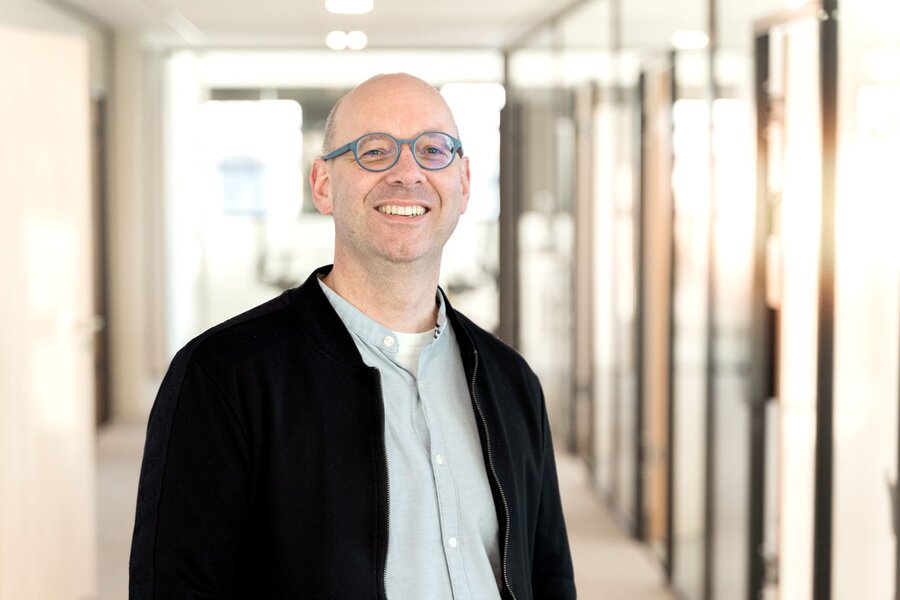
"As an engineer, I'm connected to everything and rely on feedback loops," Silvio Matysik describes his work. Fault patterns come directly from the control room, from service, from spare parts supply and from customer projects. This generates repair methods, monitoring systems and standards, developed from practice for practice. This proximity to the field is crucial: whilst OEMs look at their turbines from a development perspective, DWT views them from an operator's perspective, with a focus on long-term economic operation, availability and cost efficiency.
BBG+: From party idea to market product
Let's go back to 2015. The situation was clear: blade bearing damage was increasing on pitch-controlled turbines and there were no reliable market solutions for monitoring. At psm, Silvio's employer at the time, many of these turbines were under contract, so the problem was a daily reality. "Since there were no monitoring solutions on the market, I presented my idea to eolotec at a party hosted by BWE, the German Wind Energy Association, during Hannover Messe 2015," Silvio Matysik recalls. "We brought the 'wind turbine reality' and eolotec brought the 'measurement technology'. This created the first industrial solution for continuous blade bearing monitoring." That same year, the prototype was installed in the Hocheifel region in a DeWind D6. "Following the motto: let's measure and see what comes out of it," Silvio Matysik outlines the deliberately exploratory approach. BBG+D initially monitored wear-based patterns. Ten years of field experience with various types of damage provided continuous new insights.
When the problem evolves
"What caught us off guard: on some turbine types, cracks appeared on inner and outer rings. A completely new approach was necessary," says Silvio Matysik. The partnership with eolotec enabled the development of BBG+R for crack detection, DNV certified. "Unfortunately, blade bearing cracks cannot be prevented, but major damage and high costs can be avoided." Particularly with larger rotors, the crack problem is increasing across manufacturers and turbine types.
Unexpected applications
"For me personally, it's fulfilling to see an idea become a marketable product that can unfold unexpected potential," says Silvio Matysik. "We now use BBG+ not only for blade bearings but also for all kinds of areas on different turbine types: azimuth and main bearings, rotor blade cracks, structural components." This multi-brand capability is typical for DWT: solutions that work across manufacturers and give operators genuine independence from the OEM.
How innovation happens at DWT
The success of BBG+ demonstrates how engineering works at DWT. It's not a linear process from lab to market readiness but a continuous dialogue between all parties involved. "Every department constantly influences the other departments," Silvio Matysik describes the collaboration. "The close networking is necessary and works very well." Fault patterns from the control room provide initial clues, feedback from service shows where solutions work or where improvements are needed. Insights from customer projects flow directly into development. This organisational integration is not coincidental but strategic. "Particularly in R&D, success depends crucially on how well the team and the partner companies involved work together," Silvio Matysik emphasises. For BBG+, the partnership with eolotec was decisive, with each party contributing their specialisation.
"The topics are usually complex, so inventions emerge as a team. Everyone has their perspective and that's how you find the best solution. Additionally, we expand our service portfolio through targeted collaboration with service providers and partner companies that bring in their respective specialisations."
Further development areas
Besides BBG+, the engineering team is working on other focus areas. Further development of ultrasonic testing on fasteners is an important field. Lifetime extension of major components is also a priority: how can the lifespan of gearboxes, generators or main bearings be extended? Innovative approaches such as split main bearings enable replacement without dismantling the drivetrain and rotor, and thus without an expensive mobile crane. "Unfortunately, some R&D topics we're working on are not public," Silvio Matysik stresses the necessary discretion around certain developments.
Looking ahead
One thing is certain: with increasingly larger turbines and taller towers, cost savings are becoming the decisive factor. Major components cause the highest service costs, crane costs rise exponentially. Future topics such as GBWS, uptower cranes and predictive maintenance offer solutions here. "Since we're taking on more larger turbines under contract and these are also on increasingly taller towers, I see the greatest savings potential here," says Silvio Matysik.
DWT's ground-based winch system (GBWS) is already in operation. "I think it's necessary to take this further and extend it to other turbine manufacturers and types." The uptower crane is also on the agenda: "The acquisition costs are high and operational excellence will be a real challenge. In the long term, however, the uptower crane will play a very important role in service."
And finally: "Predictive maintenance needs to be thought through further and combined with classic CM systems." BBG+ already shows how this combination works: data-based prediction plus proven monitoring.
What counts in the end
"I can only speak for our area, and the most important metric is whether the turbine runs and everything stays in place. That's the goal," Silvio Matysik sums up the engineering philosophy of his work at DWT. The goal is not the most elegant technical solution but the most practical one. Ultimately, the turbine has to run – safely, economically and for the long term. For operators, this means more control, less dependency, long-term prospects. The next innovations are already in the works.
Click here for the first part of the interview!